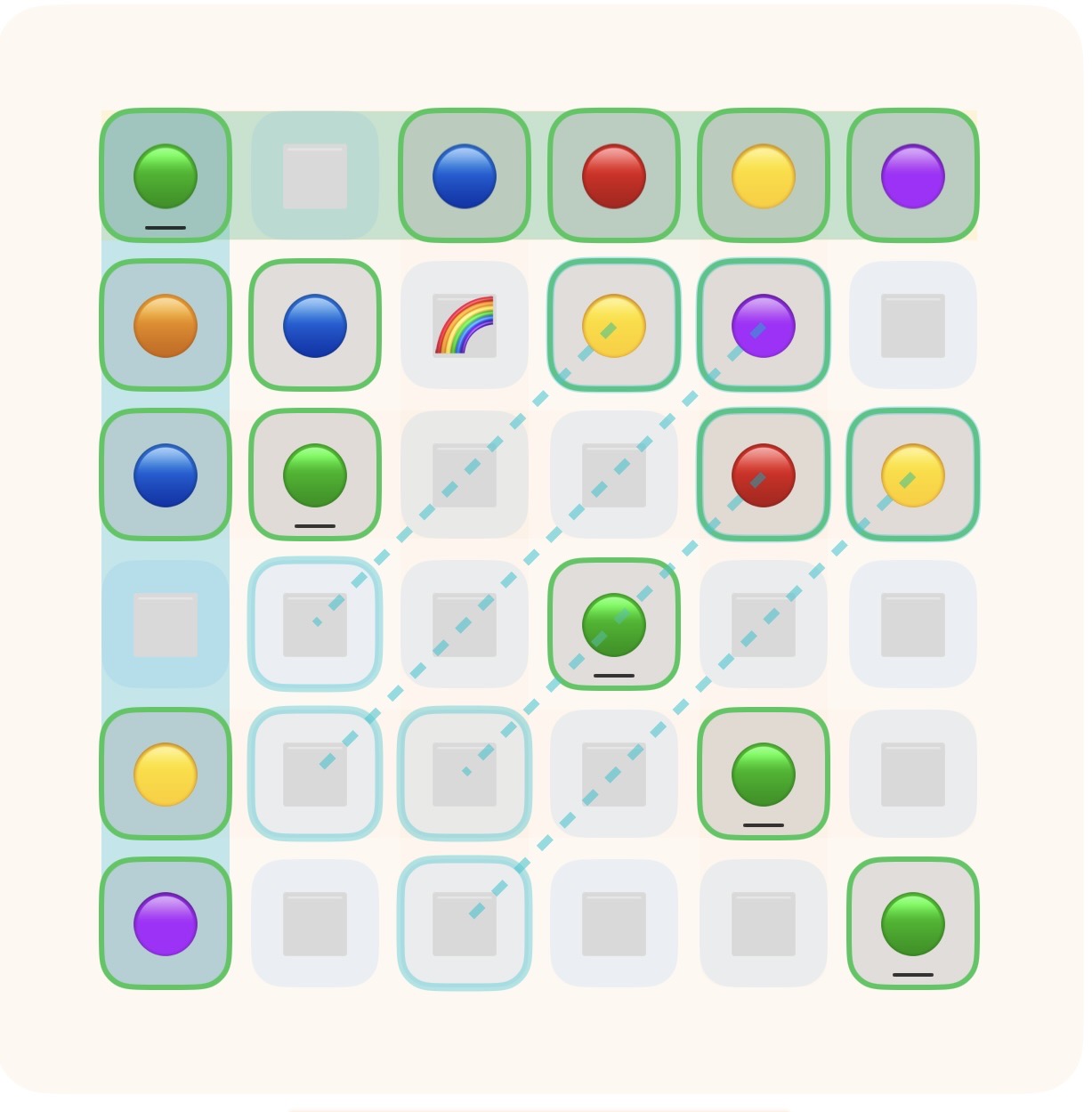
At first glance, this level can feel surprisingly open. There are not many runes already placed on the board, and the usual approach of filling rows and columns may not seem to give you much to work with.
The dashed diagonal links are where the puzzle starts to reveal its secrets.
Each linked pair represents a swap, and the two runes connected by a dashed line cannot be the same colour. That single rule creates a network of relationships across the board. A deduction in one corner can suddenly tell you something useful somewhere else.
As you follow the links from pair to pair, you may notice something interesting happening. Some of the swaps form chains that eventually loop back on themselves, creating cycles that wind around the board. Tracing those loops can be just as valuable as looking at the rows and columns.
What makes this level fun is that many of the clues are hidden in the connections rather than in the starting positions. The board may look sparse, but the dashed lines are quietly carrying information all over the puzzle.
If you find yourself stuck, try following a linked pair and asking what colours are no longer possible. Often a small observation is enough to set off a chain reaction that solves much more of the board than you might expect.